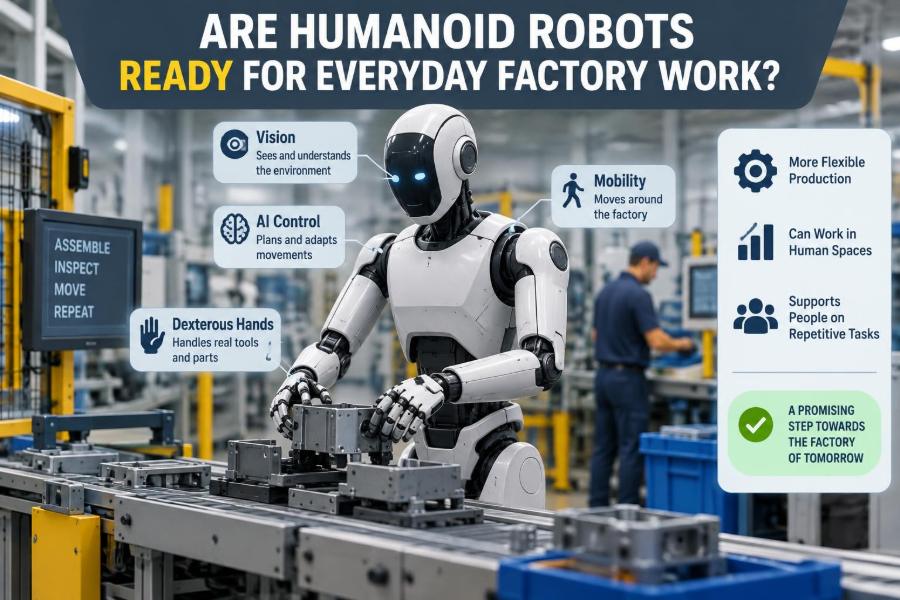

Picture a factory shift change. A cart of mixed parts is waiting beside an assembly cell, a tote has been placed slightly out of position, and a worker needs to move between a packing station and a machine that has stopped for a minor fault. None of these jobs is extraordinary. Together, they describe the messy reality of everyday manufacturing.
Traditional industrial robots are excellent when a task stays predictable: pick the same component from the same tray, weld along the same path, or place a product at the same coordinate thousands of times. But factories also contain stairs, doors, temporary pallets, changing batches, narrow walkways, and tools designed around the human body.
That is why humanoid robots have attracted so much attention. If a machine has two arms, hands, and a body that fits human workspaces, could it work wherever people already work—without rebuilding the entire production line?
The answer is more useful than a simple yes or no. Humanoid robots are becoming capable enough for carefully selected factory tasks, but everyday deployment depends less on an impressive demonstration than on reliability, safety, integration, and economics over an entire shift.
🏭 What “Everyday Factory Work” Actually Means
Everyday factory work is not one job. It includes moving materials, loading machines, sorting items, applying labels, checking quality, fastening parts, cleaning work areas, and responding to small disruptions.
A task is difficult for automation when its inputs vary. A box may be crushed, a component may arrive rotated, or a worker may have left a cart in a different place. These exceptions are routine rather than rare.
For a humanoid robot, success means more than completing a single action once. It must repeat useful work safely, recover from ordinary variation, and fit into the production system without creating more downtime than it removes.
🧍 Why a Human-Shaped Body Is Appealing
Factories have been designed around human reach, walking height, hand tools, shelves, ladders, and door handles. A robot with a human-like form can, in principle, use these environments without requiring every station to be redesigned.
Two arms also support actions that are awkward for many fixed robots: holding a container while manipulating its contents, stabilizing a part during insertion, or carrying an object while opening a door.
But human shape is not automatically optimal. Wheels are usually more efficient than legs on smooth floors, and a specialized gripper is often better than a five-fingered hand for one repeated item. Humanoid form offers environmental compatibility, not universal superiority.
🧩 The Difference Between a Demo and a Deployment
A polished demonstration commonly takes place in a prepared area with known objects, clear lighting, and engineers ready to intervene. It can still represent valuable engineering progress, but it does not prove broad operational readiness.
A deployment must address the less glamorous questions: What happens when the network drops? How is the robot restarted after a fault? Who clears a jam? Can it work around spillages, reflections, damaged packaging, and changing shift conditions?
The relevant measure is not merely whether the robot can perform an action. It is whether the complete work process remains dependable at the pace, quality level, and safety standard that the factory requires.
🦿 Mobility Is Useful, but Legs Add Complexity
Bipedal walking lets a robot navigate spaces built for people, including narrow aisles, thresholds, and locations where fixed automation cannot reach. It may eventually be especially useful in older facilities where major construction is impractical.
Yet walking is energy-intensive and mechanically demanding. Maintaining balance while carrying a load, turning near a person, or stepping over unexpected clutter requires perception, motion planning, and fast control working together.
For many indoor logistics tasks, a wheeled mobile manipulator can be the more practical choice. A mobile base with one or two arms gives up stair climbing but gains stability, simpler engineering, and often longer operating time between charges.
🖐️ Hands Are Harder Than They Look
Human hands make manipulation seem easy because people constantly adjust grip force, finger placement, and wrist angle without conscious calculation. A robot must sense and control these details explicitly.
Factory items can be slippery, deformable, sharp, dusty, or irregular. A rigid gripper may be ideal for a known component, while a dexterous hand may handle more object types but introduces more joints, control demands, and possible failure points.
Practical systems often use task-specific end effectors rather than trying to imitate every human hand movement. This is not a weakness; it is good engineering. The right tool is the one that handles the work reliably.
👁️ Seeing the Workcell Is Not the Same as Understanding It
Cameras, depth sensors, and other sensors can help a robot detect objects and estimate their position. This capability is often described as perception. In a factory, perception must remain reliable despite shadows, shiny metal, transparent wrapping, dust, vibration, and partial occlusion.
Recognizing that an object resembles a bin is only the first step. The robot also needs to know whether the bin is empty, whether it is safe to lift, where its handle is, and whether another object blocks its path.
Good automation limits unnecessary ambiguity. Consistent containers, clear presentation areas, controlled lighting, and sensible storage rules can improve robot performance more than adding another layer of software.
🧠 Task Planning Connects Perception to Action
A factory robot needs more than a list of motions. It needs to choose actions in a sensible order: approach the tote, check its position, grasp it, verify the grip, carry it, place it, and confirm completion.
This is task planning. The challenge grows when the expected route is blocked or the desired part is missing. A useful system must decide whether to retry, take an alternative route, ask for help, or stop safely.
Humanoid robots may benefit from general-purpose planning because their bodies can perform many kinds of action. At the same time, broader capability creates more possible mistakes, so tasks still need well-defined boundaries.
⚙️ Control Must Handle Contact, Not Just Motion
Many factory jobs involve contact: pushing a cart, inserting a plug, pressing a button, tightening a fastener, or placing an item into a close-fitting fixture. Tiny position errors can become large forces when surfaces collide.
Force and torque sensors, compliant joints, and control algorithms help a robot respond gently rather than rigidly. Compliance means allowing controlled flexibility when contact occurs, much like a person relaxing their wrist while fitting a part into place.
Contact-rich tasks remain demanding because the robot must distinguish a normal touch from a jam, a misplaced part, or an unsafe collision. That judgment is central to reliable assembly work.
🔋 Energy Limits Shape the Shift
A factory usually values steady output. A robot that can perform well for a short period but requires frequent recharging, lengthy battery swaps, or careful cooling may be difficult to schedule.
Legged motion, arms with many actuators, onboard computing, and sensor suites all consume power. Carrying heavy loads can increase that demand further.
Charging strategy therefore becomes part of system design. A site may use planned charging windows, spare batteries, task rotation, or a smaller number of high-value tasks rather than expecting one humanoid to cover an entire shift continuously.
📦 Material Handling Is an Early Opportunity
Moving totes, bins, carts, and small containers is one of the clearest potential uses. The work can be physically repetitive, and it often links existing islands of automation such as machines, conveyors, and inspection stations.
Humanoids may be useful where pickup and drop-off positions change, or where a facility cannot easily install fixed conveyors. Still, payload limits, reach, aisle layout, and floor conditions must be evaluated carefully.
A sensible early assignment is not “move anything anywhere.” It is a constrained route with known container types, defined handoff points, and a clear method for handling exceptions.
🔧 Machine Tending Rewards Repeatability
Machine tending means loading raw material into a machine and removing finished parts. It is already widely automated with conventional industrial robots when geometry, timing, and access are stable.
A humanoid may add value where one worker tends several different machines with different interfaces, especially if controls, doors, and fixtures were built for people. It can potentially use existing handles and work areas.
However, machine tending also punishes inconsistency. A dropped part, poorly seated blank, or delayed unload can damage equipment or interrupt production. Conventional automation may remain preferable when a process is mature and high volume.
📋 Inspection Needs More Than a Camera
Visual inspection is a possible role when a robot must move between stations and look at varied products. Cameras can identify some surface defects, missing labels, or incorrect placements under controlled conditions.
But inspection decisions carry consequences. A false rejection wastes material, while a missed defect can pass a problem downstream. The robot needs defined acceptance criteria and a traceable process for uncertain cases.
In many settings, the useful model is assisted inspection: the robot gathers images, measurements, or samples, while a validated inspection system or trained person handles borderline decisions.
🧰 Tool Use Requires a Carefully Designed Interface
People use power tools, hand tools, gauges, scanners, and keyboards with remarkable adaptability. Robots can use tools too, but every tool introduces requirements for alignment, activation, force control, storage, and verification.
A cordless driver, for example, is not simply something to hold. The robot must engage the bit correctly, maintain axial force, avoid cross-threading, recognize a failed fastening cycle, and place the tool safely afterward.
Robotic tool use becomes much more feasible when tools include locating features, automated docking, machine-readable status signals, and fixtures that guide the motion. Designing for automation is often more productive than asking a robot to imitate an unconstrained human procedure.
🧑🤝🧑 Working Near People Changes the Design Problem
Most useful factories will not become robot-only spaces. Humanoid robots may share aisles, stations, and tools with technicians, operators, cleaners, and material handlers.
That makes behavior predictable as well as safe. A robot that stops unpredictably in a walkway or swings a carried object through a shared area creates disruption even if it never makes contact with anyone.
Clear travel lanes, speed limits, separation zones, visible status indicators, and trained staff procedures are part of a safe collaborative workflow. The design question is not just “Can people stand near it?” but “Can everyone understand what it will do next?”
🛡️ Safety Is a System, Not a Single Feature
Emergency stops, collision detection, soft coverings, and force limits can reduce risk, but none of them eliminates the need for a thorough safety assessment. Risk depends on the task, payload, speed, workspace, possible failures, and nearby people.
A robot carrying a light empty tote creates a different hazard from one lifting a dense metal component. A brief arm movement at low speed differs from a mobile robot navigating a busy crossing.
Manufacturers should evaluate intended use, foreseeable misuse, protective measures, and recovery procedures. Local regulations, workplace rules, and applicable machinery safety standards shape the final requirements; they cannot be replaced by a generic claim that a robot is “safe.”
🚧 Falls and Dropped Loads Need Explicit Planning
A bipedal robot can lose balance because of a slippery patch, a misplaced object, an uneven transition, an unexpected push, or a control fault. A recovery step may itself create risk if it moves into a shared area.
Similarly, a secure grasp can fail because packaging tears, an object shifts, or the load was heavier than expected. The robot needs conservative limits and a safe response when its sensors indicate uncertainty.
Early deployments should avoid high-consequence situations: elevated work, fragile products, hazardous substances, tight spaces around people, and loads whose drop could cause injury or expensive damage.
🔌 Integration Often Takes Longer Than the Robot Setup
Installing a robot is only part of the project. It must exchange signals with machines, warehouse systems, quality records, access controls, charging equipment, and sometimes production scheduling software.
Operational details matter. The robot needs a way to receive a job, identify the right material, report completion, flag an exception, and avoid acting on outdated instructions.
A pilot can fail even if the robot itself performs well because these handoffs were not designed. Treat integration as a manufacturing project with owners on operations, maintenance, IT, safety, and quality—not as a standalone robotics experiment.
📡 Connectivity and Cybersecurity Belong on the Factory Floor
Connected robots can receive software updates, log faults, use remote support, and coordinate with other systems. Those capabilities can improve operations, but they also expand the system’s digital exposure.
Access control, network segmentation, patch management, audit logs, and clear remote-access policies are practical concerns. A robot should not have unrestricted paths from an external service into production equipment.
Availability matters too. A workflow should define what the robot does when connectivity is degraded. For some tasks, it may complete a safe local action; for others, it should stop and request assistance.
🧑🔧 Maintenance Determines Whether Capability Lasts
A robot’s value depends on its condition after weeks and months of operation, not only on its first successful day. Joints, transmissions, sensors, batteries, cables, grippers, and cooling systems all require inspection and service.
Humanoid robots have many moving degrees of freedom, which can increase maintenance needs compared with simpler machines. Dust, oil mist, vibration, and temperature swings can make the real factory harsher than a development lab.
Before deployment, teams should ask who can diagnose faults, which spares are available, how long common repairs take, and whether maintenance can occur without disrupting a critical production window.
📈 Reliability Must Be Measured at the Process Level
A robot may have reliable motors yet still cause process interruptions because it misidentifies a part, waits too long for a door, or cannot recover from a shifted pallet. Component reliability and workflow reliability are different.
Useful operational measures include completed tasks, successful first attempts, human interventions, recovery time, quality outcomes, and the causes of exceptions. The purpose is not to produce flattering metrics; it is to identify what prevents useful work.
Do not judge readiness from a single impressive run. Judge it from repeated performance across normal variation, including the awkward cases that operators encounter every day.
💰 The Business Case Is More Than Labor Cost
It is tempting to compare a robot directly with one worker’s wage. That comparison misses integration, site preparation, supervision, maintenance, training, energy, insurance, downtime, and support requirements.
It also misses potential benefits: reducing repetitive lifting, covering work during difficult staffing periods, smoothing material flow, and collecting better process data. These benefits vary greatly by factory and should be assessed honestly.
The best use case often has a clear bottleneck, a repetitive physical burden, measurable output, and manageable exceptions. A vague promise to “automate general labor” is not yet a business case.
🧪 Pilots Should Test the Real Work, Not the Best Case
A pilot should start with a bounded task and a defined success condition. It should also include the normal sources of variation: different shifts, realistic packaging, routine obstructions, and maintenance access.
Teams should record when a person intervenes and why. A frequent need to reposition objects, restart software, or guide the robot through a corner is not a minor detail; it describes the actual level of autonomy.
- Choose a task with a clear beginning, end, and handoff.
- Establish safe fallback behavior before running production work.
- Include operators and maintenance staff in test design.
- Measure exceptions as carefully as successful cycles.
- Decide in advance what result justifies expansion.
🧭 Human Oversight Is Part of the Operating Model
For the near term, many humanoid systems will use some level of supervision. That may range from a worker responding to alerts to remote assistance for rare cases that the robot cannot resolve alone.
Oversight is not necessarily evidence of failure. Aviation, manufacturing, and logistics all use automation with people responsible for escalation and unusual conditions. The key is to make the handoff fast, clear, and safe.
A poor operating model hides the need for human help until it becomes a disruption. A good one specifies who responds, what information they receive, what authority they have, and how the robot returns to service.
🎓 Jobs Will Change Unevenly, Not Disappear All at Once
Humanoid robots may reduce some repetitive handling and allow people to spend more time on troubleshooting, quality checks, changeovers, maintenance, and process improvement. The effect will differ by task, facility, and deployment quality.
New roles can emerge around robot operation, fleet coordination, safety validation, data analysis, and maintenance. Existing operators often hold critical practical knowledge about exceptions that is missing from process documents.
Involving workers early is technically useful as well as fair. The people who perform a task can identify pinch points, awkward reaches, seasonal variation, and workarounds that a project team might otherwise overlook.
🏗️ Factory Design Can Make Robots More Practical
Robots work best when the environment supports repeatability. This does not mean converting a factory into a sterile cage. It means removing avoidable uncertainty where it adds no value.
Simple changes can help: standard tote sizes, marked parking locations, protected cable routes, reachable charging areas, uniform labels, and fixtures that guide parts into position.
This principle is called design for automation. A better process helps people too, because clear material flow and fewer improvised workarounds make production easier to understand and manage.
⚖️ When Conventional Robots Are the Better Choice
Fixed industrial arms remain excellent for high-speed, repetitive jobs with stable geometry. They can be robust, precise, and straightforward to safeguard when installed in a dedicated cell.
Collaborative arms can suit lower-force tasks near people when their limitations are understood. Automated guided vehicles and autonomous mobile robots can move goods efficiently over predictable routes.
| Automation approach | Usually strongest when | Typical limitation |
|---|---|---|
| Fixed industrial robot | Task and layout are stable | Limited flexibility outside its cell |
| Mobile manipulator | Work spans stations on smooth floors | Usually cannot use stairs or human-only spaces |
| Humanoid robot | Human-designed tools and spaces must be used | Greater mechanical and control complexity |
The right question is not which robot looks most advanced. It is which system solves the required task with acceptable risk and lifecycle cost.
🔍 Common Mistakes in Humanoid Robot Planning
The most common error is starting with the robot rather than the process. Teams may buy into a broad capability claim before mapping the task, exceptions, hazards, and required performance.
Another mistake is treating human intervention as invisible. If someone must constantly prepare objects or rescue the robot, that labor belongs in the evaluation.
- Assuming walking is necessary when wheels would work.
- Testing only clean, perfectly presented materials.
- Ignoring charging, maintenance, and shift handover.
- Expecting a general-purpose robot to replace process engineering.
- Expanding before a small workflow is reliably controlled.
🗺️ A Practical Readiness Checklist
Before assigning a humanoid robot to a factory task, define the job in operational terms. What objects will it handle? Where do they come from? What variation is expected? What is the maximum acceptable recovery time?
Then examine the surrounding system: people, machines, network connections, floor conditions, tools, safety controls, training, and support. A technically capable robot can still be the wrong choice if the surrounding operation is unprepared.
- Map the current task, including exceptions and informal workarounds.
- Compare humanoid, fixed, wheeled, and manual options.
- Perform a task-specific safety and risk assessment.
- Run a bounded pilot under realistic operating conditions.
- Review process-level reliability, quality, and intervention needs.
- Scale only after the workflow—not just the robot—has proved workable.
🌱 Where Humanoids May Fit First
The earliest practical uses are likely to be structured but flexible tasks: handling standardized materials across several nearby stations, operating simple human-oriented interfaces, or assisting with repetitive work that changes too often to justify fixed automation.
These deployments will probably occur in environments that are partly prepared for the robot and supported by people. That is not a compromise; it is how most industrial automation matures.
Over time, better perception, manipulation, energy systems, and operational tooling may broaden the range of feasible work. Progress should be evaluated through sustained performance in real workflows, not by appearance alone.
✅ The Core Principle: Match the Robot to the Work
Humanoid robots are not yet a universal answer to factory labor. They are a developing class of tools with a meaningful advantage when a task truly requires a human-compatible body in a human-built environment.
For stable, high-volume processes, specialized automation will often remain the stronger option. For variable tasks in existing facilities, a humanoid may eventually offer flexibility that would otherwise require major redesign—but only when safety, support, and reliability are engineered into the whole operation.
The most productive view is neither hype nor dismissal. Treat a humanoid as one option in an automation portfolio, then test whether it can create dependable value in a clearly defined job.
Humanoid robots are ready for selected factory tasks when the process is designed around realistic limits, not when the robot merely looks capable of doing human work. The factory, the workflow, and the people around the machine are all part of the solution. 🦾🏭🔧